


Blog
How Becky Stern Makes a Vape Synth: Turn E-Waste Into a Musical Instrument

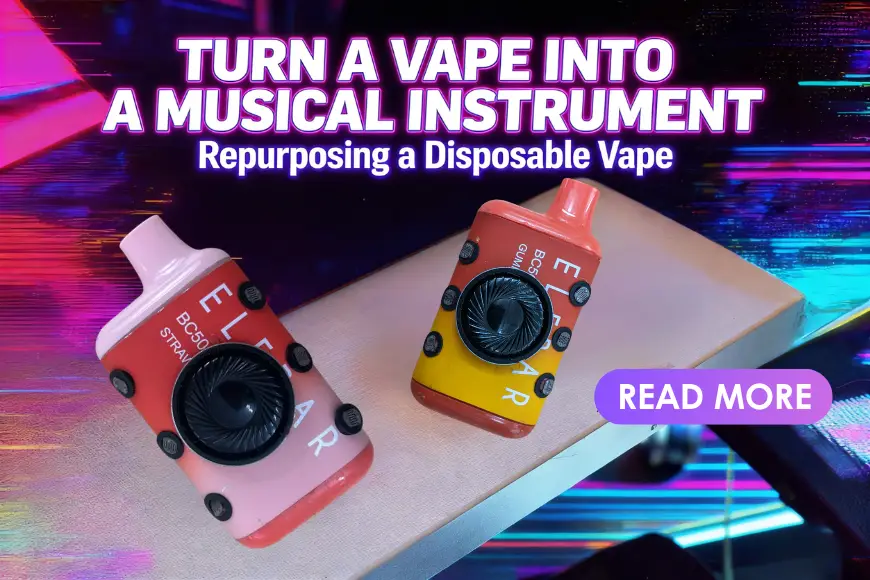
Time: 2–3 hours | Difficulty: Intermediate (basic soldering required)
Best for: DIY enthusiasts, electronic musicians, and anyone who wants to turn a disposable vape into something musical instead of sending it to a landfill.
In a clever response to planned obsolescence and the growing mountain of electronic waste, maker Becky Stern — together with Shuang Cai, David Rios, and Kari Love — has transformed one of the most problematic modern e-waste items into a playable musical instrument: the Vape Synth.
This breath-controlled, light-sensitive device works like a digital ocarina. Instead of sending lithium batteries and precision sensors to a landfill, the project reuses internal components to generate sound — blending sustainability, DIY electronics, and experimental music in one compact build.
What Is a Vape Synth?
The Vape Synth is a small analog wind instrument built from a repurposed disposable vape. It uses the device’s original pressure sensor for breath activation and a 555 timer circuit to produce sound.
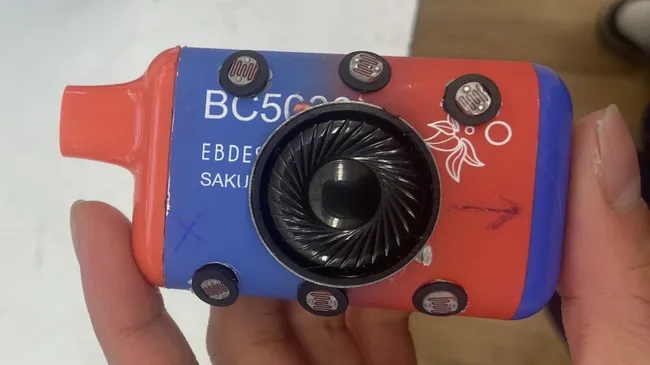
Pitch is controlled by photoresistors (light-dependent resistors, or LDRs): covering holes with your fingers changes light exposure, which alters the tone — just like playing a traditional ocarina. Blow into the vape’s original air channel, and the synth sounds. Cover different holes, and the pitch changes.
Full Bill of Materials (BOM)
From the Disposable Vape
- Working disposable vape (functional battery and charging circuit)
- Internal pressure sensor (usually a small MEMS or diaphragm switch)
- Original outer enclosure (aluminum or plastic shell)
Electronic Components
- 555 timer IC (the core oscillator for sound generation)
- 3–5 photoresistors (LDRs, 5–20kΩ dark resistance)
- Small 8Ω speaker (0.5–1W)
- Breadboard (for prototyping)
- Perfboard (for final soldering)
- Capacitors: 0.01µF, 0.1µF, 10µF (electrolytic)
- Resistors: 10kΩ, 100kΩ, 470Ω
- Stranded wire and hookup wire
- Kapton tape (thin, heat-resistant insulation)
Tools
- Drill and drill bits (or step drill bit)
- 3D‑printed drilling jigs (optional, for accurate hole placement)
- Pliers and vise (to safely open the vape)
- Soldering iron and solder
- Hot glue gun
- Compressed air (to quickly set hot glue)
- Deburring tool (to smooth drilled holes)
- Center punch (to prevent drill slippage)
- Safety gloves and eye protection

⚠️ Important Safety Notes (Read First)
This project is for educational and experimental purposes only. Please follow these safety guidelines carefully:
- Lithium‑ion batteries can catch fire or explode if punctured, bent, or short‑circuited. Do not pry directly into the battery.
- E‑liquid may be toxic and absorbable through the skin. Always work in a well‑ventilated area and wear gloves.
- Avoid direct contact with internal vape parts. Wash your hands thoroughly after handling.
- This modification does not endorse or encourage the use of vapor products.
- Only use empty, expired, or discarded vapes — never a partially full device.

Circuit Deep Dive: How the 555 Timer and LDRs Work Together
The heart of the Vape Synth is a 555 timer configured as an astable oscillator (it produces a continuous square wave). The frequency of that wave — the pitch you hear — is controlled by a resistor‑capacitor (RC) network.
Here’s the clever part: instead of a fixed resistor, you use photoresistors (LDRs) in series with small fixed resistors. When you cover an LDR with your finger, less light hits it, its resistance goes up, and the pitch drops. When you uncover it, resistance goes down, and the pitch rises.
Simplified Circuit Connections (No Schematic Required)

| 555 Pin | Connection |
|---|---|
| Pin 1 (GND) | Battery negative (−) |
| Pin 2 (TRIG) | Connected to Pin 6 (THRES) and the LDR/resistor divider |
| Pin 3 (OUT) | Through a 10µF capacitor → to 8Ω speaker (+) |
| Pin 4 (RESET) | Connected to VCC (or to the pressure sensor output for breath control) |
| Pin 5 (CONT) | 0.01µF capacitor to GND |
| Pin 6 (THRES) | Connected to Pin 2 and the LDR network |
| Pin 7 (DISCH) | Through a 100kΩ resistor to VCC |
| Pin 8 (VCC) | Battery positive (+) |
LDR arrangement: Connect one end of each LDR to Pin 7 (DISCH) through its own 10kΩ fixed resistor. The other end of each LDR goes to Pin 2/6. When you cover an LDR, its resistance increases, slowing the charging of the timing capacitor — lowering the pitch.
How to Use the Original Pressure Sensor?
Most disposable vapes contain a simple pressure switch (not an analog pressure sensor). When you inhale, a membrane moves and closes a circuit. That’s perfect for this project.
Two ways to integrate it:
- Simple mode (recommended for beginners): Connect the pressure sensor’s output to Pin 4 (RESET) of the 555 timer. When you blow into the vape, the sensor pulls RESET high — the oscillator runs. When you stop blowing, RESET goes low — silence. This gives you breath‑controlled on/off.
- Advanced mode: Use the pressure sensor to control a transistor that varies the 555’s voltage or to gate a second oscillator. This requires more experimentation.
Tip: Before soldering, use a multimeter in continuity mode to identify which two wires from the vape’s board close when you gently blow into the device.
Step‑by‑Step Build Instructions
Step 1: Safely Open the Vape
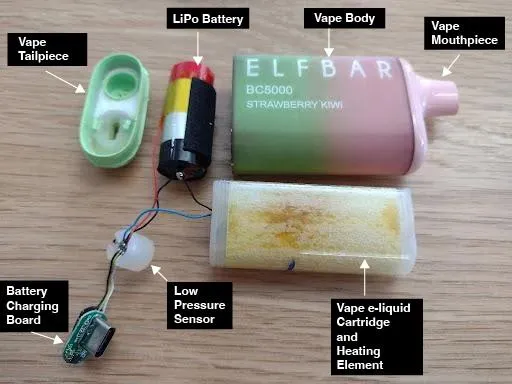
- Put on gloves and eye protection.
- Use pliers and a vise to carefully remove the plastic or aluminum shell. Avoid bending the battery.
- Identify the battery, pressure sensor, and LED (if present). Remove only the pressure sensor and battery — leave the rest.
Step 2: Drill Finger Holes (Pitch Control)
- Mark 4–6 positions along the vape body where your fingers naturally rest.
- With 3D‑printed jig: Align jig and drill straight holes (3–4mm diameter).
- Without a jig: Use a center punch to mark each spot. Start with a 1mm pilot hole, then enlarge to 3mm. Smooth edges with a deburring tool.
- Paint the inside of each hole with black marker or tape to reduce ambient light interference.
Step 3: Mount the LDRs
- Glue one LDR behind each hole using hot glue (clear glue lets light through). Make sure the LDR faces directly into the hole.
- Solder a 10kΩ resistor to one leg of each LDR. Connect the other side of the resistor to Pin 7 (DISCH) of the 555.
- Connect the second leg of each LDR to Pin 2/6 (TRIG/THRES).
Step 4: Build the 555 Oscillator on Perfboard
- Follow the pin table above. Keep wires short.
- Solder the 10µF capacitor between Pin 3 (OUT) and the speaker (+) terminal. Connect speaker (−) to GND.
- Test the oscillator with a 9V battery before connecting the vape’s lithium battery.
Step 5: Integrate the Pressure Sensor
- Solder one wire of the pressure sensor to VCC. Solder the other wire to Pin 4 (RESET).
- Add a 10kΩ pull‑down resistor from Pin 4 to GND (so RESET defaults low).
Step 6: Power the Synth
- Use the vape’s original lithium battery (typically 3.7V). Connect positive to VCC, negative to GND.
- Important: Do not let the battery short. Insulate all exposed connections with Kapton tape or heat shrink.
Step 7: Final Assembly
- Hot‑glue the perfboard inside the vape shell.
- Align the speaker with a vent hole.
- Close the shell (use tape or a small screw if needed).
If any part of this process feels a bit unclear, please refer to the following tutorials. They offer a much more polished and detailed breakdown of the build.
2.
3.
Troubleshooting Table
| Problem | Likely Cause | Fix |
|---|---|---|
| No sound | 555 not oscillating | Test with a known working 555 and fresh battery |
| Speaker silent, 555 warm | Short circuit | Check solder bridges between pins |
| Pitch doesn’t change when covering holes | LDR exposed to constant light | Cover back of LDR with black tape |
| Pitch changes randomly | Ambient light leakage | Paint inside of holes black |
| Battery gets hot | Reverse polarity or short | Disconnect immediately, recheck wiring |
| Pressure sensor doesn’t trigger | Wrong pins or sensor damaged | Use multimeter continuity test; replace if needed |
Are Disposable Vapes Recyclable?
Most disposable vapes are not accepted by standard curbside recycling programs. They contain mixed materials — lithium batteries, plastic, metal, and circuit boards — requiring specialized processing. Many recycling centers reject them due to internal batteries and residual e‑liquid.
This is why upcycling projects like the Vape Synth are so valuable: they give these “unrecyclable” items a second life instead of letting them accumulate in landfills.
What to Do With Old Disposable Vapes (Instead of Trashing Them)
- Repurpose them into DIY projects like the Vape Synth
- Drop off at dedicated battery recycling centers or hazardous waste facilities
- Check local vape shops — some offer in‑store take‑back programs
- Harvest reusable parts: batteries, sensors, charging circuits, LEDs, and enclosures
How to Reuse Empty Vapes (Beyond the Synth)
- Harvest the lithium battery for small LED projects or portable chargers
- Reuse the pressure sensor for breath‑activated fans or air‑flow indicators
- Turn the aluminum casing into a rugged enclosure for a mini amplifier
- Build simple oscillators, noise boxes, or light‑follower robots
FAQs
Can any disposable vape be used?
Most standard disposable vapes with a working battery and pressure sensor work. Different models may require small adjustments to fit the circuit. Avoid devices that are physically crushed or leaking.
Is it dangerous to take apart disposable vapes?
When done carefully, risk is low — but real. Lithium batteries can catch fire if damaged. E‑liquid can irritate skin. Always wear gloves, work in a ventilated space, and never puncture the battery.
Do I need soldering experience?
Yes — basic soldering is required. If you’re new, practice on scrap wire first. The 555 circuit is forgiving, but cold joints will cause intermittent problems.
Can I make this without a 3D printer?
Absolutely. The jig only helps with accuracy. Mark holes manually with a pen and center punch, then drill carefully. The rest of the project uses hand tools only.
What if my vape’s battery is dead?
You can replace it with any small 3.7V–5V lithium cell (e.g., from an old Bluetooth headset). Do not attempt to revive a swollen or damaged battery.
Final Note
The Vape Synth isn’t just a quirky instrument — it’s a statement. It shows that the electronics we throw away still contain valuable, functional parts. With basic soldering skills and a little creativity, you can turn a piece of environmental waste into something expressive, weird, and wonderful.